Friday, 7 October 2016

On going Research

Stanislavsky's technique:
Konstantin Stanislavsky based his system on how an actor should do something in order to want something and therefore should feel something naturally rather that artificially. The actor should become so consumed with their objective of carrying out something that they become immersed in their task and don't think so much as just 'do' it.
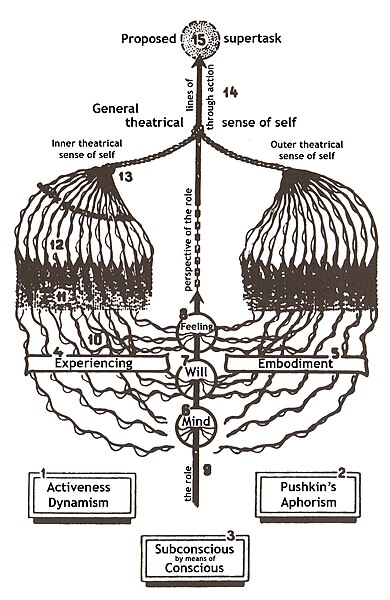
File:Diagram of Stanislavski's 'system'.jpg
Diagram of Stanislavski's system (taken from https://en.wikipedia.org/wiki/Konstantin_Stanislavski)
Meisner's Technique: 
Stanford Meisner came up with the method of getting actors to 'get out of their heads' and act on instinct much alike Konstantin Stanislavsky's method.

Melodrama was big before Stanislavski's time but after becoming a practitioner he decided that he wanted to challenge the style of theatre at the time. His ideas were a reaction to melodrama and allowed him to come to terms with the other possibilities that he could tap into. He decided to challenge the way an actor could control their emotions and the effect that that could have on their performance. Because of this, he was a big influence on the modernisation of a more naturalistic form of theatre. His work was wonderful and weird to his audiences at the time and many of his audiences didn't appreciate his style but others adored it.

One of the things that Stanislavski didn't like was the fact that in melodramas, the stereotype of the person was more important than the character. Stanislavski didn't believe this and thought that their had to be a real connection between the actor and the character as well as between each character when on stage. His work wasn't meant to be a demonstration of a show so much as it was supposed to be a demonstration of life. In order to create archetypes, they were given fixed movements and stereotypical fates that were always expected. This made theatre in Stanislavski's time very similar and repetitive; he wanted to bring something new to the table.

Some examples of archetypes:
The weak female
The damsel in distress.
The Fool/clown/idiot.
The Hero (protagonist)
The villain (antagonist)
The Genius
The Lovers

The theatre has developed a lot over the years:
- There is a lot more diversity, including colour blind casting
- Poverty porn and freedom of speech is accepted because the social reform has changed and so we can now alk about risky subjects
- Multimedia is used in a creative way and is cconceptual so makes allegorical statements
- We no longer just perform in proscenium arch
E.g Theatrical configuration:
Proscenium arch
End on
Thrust
The apron
Triverse
Promenade
The round
- Lots of things have influences from theatre created years ago e.g:
The limelight - limestone would be used to fuel the lights that lit a theatre. 'Being in the limelight' is now a well known saying
-Tilted stage - Some theatres still have tilted stages (e.e the Lyceum in Sheffield). Originally done because instead of the audiences rows being raised, instead the stage was which allowed the audience to see them
- The vom/vomitoria - an entrance which we still have in theatres now, the only difference is that in greek time, the audience would eat and then force themselves to vomit in these areas so that they could continue eating.
- Legs cover cables

Now Stanislavski is revolutionary and created his system through experimentation with actors across 30 yrs. He came up with his take on naturalism and realism because he wanted to create life as realistic as possible. He wanted to focus on the character and their issues so that the audience could become emotionally involved in the structure and storyline. 

Note: Naturalism is theatrical realism

Lesson 5

Todays rehearsal was successful in the sense that everyone was finally off book and so were able to commit to their character and perform to a higher standard. I really want to work on making our scene less static, I will have to do this by perhaps imagining that there is an elastic band between Konstantin and Sorin so that we are able to balance the space but also have moments of closeness where support can be given. Although, I do like it to a certain extent because it represents Konstantin's and Sorin's closeness and the confidence he has in himself when around his Uncle. As nice as what the closeness and staticness may be symbolistic to me, I still need to make good use of the space without losing Konstantin's and Sorin's connection and bond.

One thing I have been struggling to do is use Stanislavski's system completely in the sense that I often lose my objective out of habit and therefore go completely against his teachings. I am able to understand both what my objectives are and how to deliver my lines but when merging both those things together they don't mix together very well. Therefore in order to develop as an actress, I need to work on nailing my objectives every time.

We then went onto doing a run through in The Space.  The run through started off with my group's scene and to be honest our performance was embarrassing. It was the second time performing in front of everyone and so obviously we were all very nervous, then there was trying to remember our objectives and actions as well as our lines. I for instance, didn't cope very well when being stopped and asked for my action spontaneously, instead I panicked and then throughout the scene I was too busy trying to think about my actions that I started to forget my lines. Our scene then had to be changed around a bit and instead of Sorin and Konstantin noticing Masha and Medvedenko later in the scene, we see them from the start and so our actions had to change. I wasn't very good at simultaneously coming up with my new actions on the spot which is perhaps something I should work on but isn't necessarily a downfall.

Our director told us that our scene was quite bland at times which was such a shame after the hard work we'd put into it. He then got a group that were doing the same scene as us to perform so that we could watch and get a better understanding of the scene. After watching the performance I feel as though I now understand some of our criticism. For example, although the play is naturalist, it still isn't today's modern version of naturalistic. I knew this of course but it completely slipped my mind when getting up and performing. Therefore my personal downfall would probably be underacting. I will work on upping my game and perhaps be a bit more literal which should bring with it more confidence to explore the space and a better delivery of lines. I will go over the mechanics of breathing to also help with the delivery of my lines and will remember that any moments of silence in the scene need to be deserved and truthful.. My response to the space should come across opinionated, strong and in a way that intrigues the audience.

Saturday, 1 October 2016

Lesson 4

In today's rehearsal we focused on being playful and taking risks. One thing that my partner and I did was try to make each other mad. My partner tried to get me worked up because in our scene Konstantin is on the verge of a mental breakdown because he doesn't think his mother loves him. On top of that he is unsure of whether he will be putting on a show if his love -Nina, doesn't show up soon because she's also the star in his play and it's due to start soon. My character is very dubious and unsure of his importance in society and so because of this, my partner playing Sorin, tried to get me worked up by shoving me whilst I was delivering my lines. This was almost a physicalized version of my emotions. It was as though, every word I said had an effect that got me down but I also got annoyed at the same time which allowed me to access a different vocal range that expressed different emotions. This exercise really allowed me to tap in with what Stanislavski wanted his actors to access and as I result I responded to my stimulus accordingly and purely from instinct.

In contrary, I had to take into consideration the fact that Sorin was boring me with long philosophical responses that sounded intellectual but didn't help my character at all. I also got quite fed up with some of his responses (e.g 'Your Mother adores you') because my character was so wrapped up with different ideologies that what Sorin was saying just seemed like lies. Nonetheless, Konstantin loves Sorin most (well apart from Nina) because he's one of two that has faith in him and his performance. This is shown in Sorin allowing him to put a show on in his theatre. Because of given circumstances like this, I can't allow Konstantin to lash out at Sorin because he'd do nothing to hurt his Uncle. In fact, he respects his uncle and so has to act in a certain way (especially during the time of the play and the way in which people had to present themselves and respect their older under all circumstances).

Sunday, 25 September 2016

Lesson 3

The main thing that I learnt today was that 'Every scene is a chase scene' and to use the space efficiently during the chase. There was also an element of allowing myself to get so lost that I get fearful which makes me want to protect myself and therefore causes me to act instinctual rather than stereotypically. This meant that I had to open myself up and as Konstantin, allow myself to have the fear of not fitting in. In order to do this I tried to engage with the emotions I had when I used to get bullied in primary school. 

When rehearsing the scene, the acting itself was fine but there was a clear problem with the staging because Masha and Medvedenko seem to come into the space, sit down and chat and then Konstantin and Sorin do the same. This makes the scene very static and puts everything on the same level. In order to change this I think I will have Konstantin playing 'To impress' because as an insecure person he should feel the need to impress his uncle in order to be accepted and fit in. This will allow me to move him around and have him standing up so that he can '(To) perform' to his Uncle.

Stanislavsky: "Solitude in public - using different circles of attraction on stage to focus the attention on stage: refocus upon an object of Attention is lost and create circles emanating around that object"

In my scene, Konstantin's circle of attention is private because he is sharing his feeling with someone else however he knows that what he tells his Uncle will only ever be spoken about between the two of them. It is confidential and private to them both. If other characters came into the scene then Konstantin wouldn't talk about anything he does talk about in the scene.

Later on in the day, we watched one of the scenes back and it was amazing. Tara and Leane performed and their objectives were extremely clear after our director intervened. At first it seemed as though there wasn't a complete understanding of objectives and that the scene was still being acted and rehearses. To fix this, Will gave Tara the physical objective of 'Yo leave' and Leane the objective of 'To keep from leaving' much alike the task we had originally in our first lesson. This tactic actually worked great in this scene because Medvedenko is in love with Masha but the feelings aren't reciprocated. This meant that Tara didn't have to pretend to leave or want to get away, she simply just did try to leave but Leane made sure she blocked her each time. The actress' played the scene differently each time they re-did it which kept it fresh, fun and instinctive. Their performance was amazing and has really inspired me to try and reach their level of understanding with Stanislavski's system next week.

Lesson 2

In Today's lesson we did an exercise which included the class getting into pairs. I was with Tianna and we had to give ourselves actions to do; for example 'to stare' which meant that I would have to look at Tianna constantly, then I would perhaps go onto 'to ostracize' and continue to make her feel uncomfortable. I chose 'to belittle' and so I pushed, grabbed, shouted and bullied my partner so that they felt inferior to me. I only managed to do this by conjuring up real emotions rather than my usual acting technique. Another example of this would be instead of A trying to trip B over, B would have to try and not allow A to trip them over. If A did trip B over, then it would be genuine and realistic.

This exercise allowed us to understand how to apply actions to text and thus create an objection that could be carried out in a believable and naturalistic way. This is part of Stanislavsky's theory in connection to naturalism and it included one rule: to be truthful. I as an actress had to react on instinct rather than a delayed thought or rehearsed idea. I found Stanislavsky's technique quite difficult, especially if an action was 'to be aggressive' because I like to have full control over my actions rather than forcing myself to lash out to an extent. However, I did really enjoy experimenting with how to push myself into an almost limbo land that didn't rely on thought.

Later in the lesson, we were given our roles for 'The Seagull'. I was given Konstantin in Act 1 Scene 1 and decided to change the male role into a female role. I haven't edited the text however the play is naturalistic and there's nothing naturalistic about a female pretending to be a male (in the time of the play anyway). We then read through the script a few times but didn't have enough time to get the work on its feet.

Lesson 1

Todays lesson was basically an introduction to studying 'The Seagull' and so quite a lot of the lesson was spent reflecting on Stanislavski's system and figuring out 'how not to act'. We also worked on giving ourselves physical objectives e.g 'To leave' or 'To stay'. This meant that we had to achieve our objective whilst acting and we were told to do this using only one word. For example, once in pairs, A was given the physical objective 'To leave' and had a psychological objective of 'To not hurt' and they could only say the word 'Yes' whilst B was given the physical objective 'To keep from leaving' and the psychological objective 'To love' whilst only being able to say 'No'. This meant that A had to leave without hurting B's feelings which proved very difficult especially since B was completely in love with them.

During this task I was B and I found that the task was very effective and proved that words don't matter so much as how they are portrayed. I learnt this because delivering just the word 'No' was just as effective as asking my partner not to leave -if not more so.

It really allowed me to be:
- Spontaneous
- Act on instinct
- Create emotion in my voice
- Play around with the way that I said the word 'No'

We then went onto doing 4 moving freeze frames to show our objectives. This was quite interesting because at first we did this with no words and then we added in 4 words. I'd never before experimented or thought about how just feeling so strongly about something or being so committed to an objective couldn make it come across so effectively.

We then put on a little performance as a class that ties everything that we had done together. It was really fun. The performance started off with us all milling in the space and then we took one of the audience members hands and asked them something like 'have you seen him?', then we took them over to our partner and started having a conversation which we included them in. For example, our scene went something like this:

B - You packed?
A - Yeah but do we have to go? I want to go to her...
B - You don't know what you're saying! You need to sober up
A - ...Please understand
B - Understand you?
A - It's best for the both of us
B - No, you don't understand what you're saying. I'm the one you love. Remember?
etc.

Having an audience member in our scene meant that I was then able to interact with them and accuse them of being the person that A wanted so badly and my objectives of 'to keep from leaving' and 'to ignore' turned into 'to hate' and 'to torment'. This was completely performed from instinct though because we had to act according to the audience which went very well.

The scene then went onto the freeze frames and finished with the yes and no partner work.

I also really liked watching the other groups and it was very clear that we all made very different choices when putting on a performance. For instance, Simon's class took a comedic approach to the task at hand which was enjoyable and hilarious. Whereas Sarah's class were very serious and had a strong ensemble. I really like the use of paper folded in half to represent the seagull. The way that the actors moved the pieces of paper really made the experience magical and gave the paper a bird like quality.

Exercises

Warm ups

We all found our neutral standing positions before beginning to take in deep breathes whilst lifting our arms from our sides to meet above our heads. Then as we released our breath, our arms were extended in front of us and gradually got lower towards the ground as our breath continued to be exhaled. We continued to do this for about two minutes so that we all gave our focus and attention to our director. This exercise allowed us to all calm down so that we were ready for proceeding exercises.

Semi-Supine

We then split into our classes where we got into semi-supine and purely concentrated on our breath. By concentrating on our breath we didn't allow ourselves to become distracted or to become disengaged with the lesson. Semi-supine allowed us to become relaxed and also allowed gravity to align our bodies into the structure that bad habits sometimes force us out of. For example, carrying a rucksack can cause people to hunch over or for their shoulders to be at an uneven alignment. It also forces the body to allow the correct amount of oxygen to enter and exit the body.

Partners

We then got into pairs and one person got into a table position while the other person applied pressure to their back. The person that took up the table position elongated their back as they exhaled and arched it as they inhaled. This was done so that breath could be appreciated.

Tongue Twisters

We went on to doing tongue twisters. This was a little tricky however I'd say that the hardest part was the fact that we'd never heard the rhyme before rather then actually getting tongue tied. This exercise will come in handy when we begin to learn our lines for 'The Seagull' because it will allow us to improve our articulation. This will allow us to deliver a a good performance so long as our projection is good.

Act on Instinct

A big part of Stanislavski's theory is about spontaneousness and in todays exercise we were told what to do but weren't given direction and as a result had to engage with others and act on instinct.

Gently waking up our potential aka Hiatus Breath


We got into semi supine which aligned our bodies and made it a lot easier for our instinctual breath to accumulate. If this didn't work straight away then one way of kick starting the instinctual breath was by forcing the body to inhale filling the body with oxygen from the stomach and then the chest. Then when exhaling, releasing that oxygen from the stomach then the chest. Then push out all the oxygen using the stomach muscles and then when you gasp for your next breath, the body should naturally resume breathing in the way you were forcing it to before, but naturally this time. I had to use this technique to get my instinctual breath started. I also found that I could only achieve and instinctual breath lying down, once standing I found it virtually impossible to naturally maintain it.


Unvoiced Fricatives

The key to voiceless fricatives is using the front of the mouth for modulation and articulation


Straw breaths


I did this exercise at home and it consisted of putting a straw in your mouth and breathing through it. This minimized the oxygen intake and therefore meant that the stomach muscles and diaphragm had to work had and completely in order to deliver lines.


Staccato and Legato

We were given lines from the text, for example 'I am the Seagull' and 'My dear, I know what keeps you here'. We then changed the way that we pronounced the words and the speed at which they were delivered. When delivered in staccato, each word was very sharp and although the text still flowed, each word stood alone. Then when delivered in Legato, the words ran into each other and were elongated as each syllable was emphasised on. This exercise helped me with me pronunciation and diction. Breath also played a part and in legato, we tried to deliver the line with one breath and so had to store our breath in our diaphragm whilst using our stomach muscles to slowly release oxygen in a controlled way. Doing this sometimes allowed a 'dark L' to be released thanks to the alveolar ridge which can change the sound and structure of the vibrations that exit the mouth.


Humming


Whilst in semi supine, we worked on a closed mouth hum so that we could experiment with our vocal range. This went on to us humming with an open mouth so that our glottal folds could be used to their full potential. We were releasing open vowel sounds but varied the pitch. The good thing with humming is that it is virtually impossible to damage the vocal chords whilst performing them but hums allow the vocal chords to vibrate fully. We focused on trying to use our stomach muscles rather than creating tension in our necks or back because that would cause a strain and bad voice.

Controlled Spinal Rolls

In prayer position we were able to encourage breath to enter our intercostal muscles which would allow a full intake of breath to be achieved. We then slowly got up by getting into a crouched position with our head down to the ground. We then performed ten spinal rolls making sure that it was the core that was doing the work so that there was no tension anywhere else.


Circles of attention

This consisted of 3 circles: 
1 - Personal (inner emotions and sounds)
2 - Private (what you share with others if you want to. Also character)
3 - Public (for everyone. Taking into consideration the people around you that are acting)

Saying what you see

We got into groups of 3; two actors played around and responded using only themselves as a stimulus whilst the other actor watched what was going on and shouted out the pairs individual physical objectives. This meant that the two people acting had to make strong choices that displayed their action fully so that the actor watching could guess the same one. If the one watching said the objective was something different than what it was intended to come across as, the actor performing that objective had to work harder. This exercise was good because it gave us an idea of how much we had to do to make our physical objectives clear.

Remove tention

Our partners were asked to lay in semi supine on the floor, we then then lifted their head gently and rocked it around slowly to make sure that our partners were really relaxed and giving us all their dead weight. After this, we lifted our partners a little so that we could use our hands to scoop from the scapular. If we found any tension along the way we did the 'Place-Press-Push' technique of applying different amounts pressures to the areas. We then moved onto arms where we massaged along the biceps, triceps, forearm and shoulders before going onto the hands and fingers where we removed tention from between metacarpals by pulling all of the tension from each finger and throwing it into the air. And then last but not least, we held onto our partners arms and lifted them mid air so that their body hung limply off of the ground. I was able to do this by putting my weight into my legs and allowing my partner to lull in the air.
This was beneficial because it allowed tention to be released while warming up the muscles within the body and connecting them with their surrounding. The semi supine also allowed a connection to be felt with breath and finding one's neutral. It was also a trust exercise because you had to open yourself up and free the mind in order to relax and allow someone else to be intimate with you. Having our shoulders pushed into the ground also allowed the upper body area to open up which made breathing easier.