Stanislavsky's technique:
Konstantin Stanislavsky based his system on how an actor should do something in order to want something and therefore should feel something naturally rather that artificially. The actor should become so consumed with their objective of carrying out something that they become immersed in their task and don't think so much as just 'do' it.
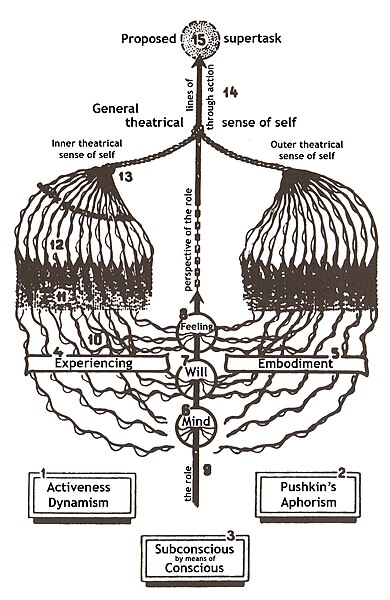 |
| Diagram of Stanislavski's system (taken from https://en.wikipedia.org/wiki/Konstantin_Stanislavski) |
Meisner's Technique:
Stanford Meisner came up with the method of getting actors to 'get out of their heads' and act on instinct much alike Konstantin Stanislavsky's method.
Melodrama was big before Stanislavski's time but after becoming a practitioner he decided that he wanted to challenge the style of theatre at the time. His ideas were a reaction to melodrama and allowed him to come to terms with the other possibilities that he could tap into. He decided to challenge the way an actor could control their emotions and the effect that that could have on their performance. Because of this, he was a big influence on the modernisation of a more naturalistic form of theatre. His work was wonderful and weird to his audiences at the time and many of his audiences didn't appreciate his style but others adored it.
One of the things that Stanislavski didn't like was the fact that in melodramas, the stereotype of the person was more important than the character. Stanislavski didn't believe this and thought that their had to be a real connection between the actor and the character as well as between each character when on stage. His work wasn't meant to be a demonstration of a show so much as it was supposed to be a demonstration of life. In order to create archetypes, they were given fixed movements and stereotypical fates that were always expected. This made theatre in Stanislavski's time very similar and repetitive; he wanted to bring something new to the table.
Some examples of archetypes:
The weak female
The damsel in distress.
The Fool/clown/idiot.
The Hero (protagonist)
The villain (antagonist)
The Fool/clown/idiot.
The Hero (protagonist)
The villain (antagonist)
The Genius
The Lovers
The Lovers
The theatre has developed a lot over the years:
- There is a lot more diversity, including colour blind casting
- Poverty porn and freedom of speech is accepted because the social reform has changed and so we can now alk about risky subjects
- Multimedia is used in a creative way and is cconceptual so makes allegorical statements
- We no longer just perform in proscenium arch
E.g Theatrical configuration:
Proscenium arch
End on
Thrust
The apron
Triverse
Promenade
The round
- Lots of things have influences from theatre created years ago e.g:
The limelight - limestone would be used to fuel the lights that lit a theatre. 'Being in the limelight' is now a well known saying
Proscenium arch
End on
Thrust
The apron
Triverse
Promenade
The round
- Lots of things have influences from theatre created years ago e.g:
The limelight - limestone would be used to fuel the lights that lit a theatre. 'Being in the limelight' is now a well known saying
-Tilted stage - Some theatres still have tilted stages (e.e the Lyceum in Sheffield). Originally done because instead of the audiences rows being raised, instead the stage was which allowed the audience to see them
- The vom/vomitoria - an entrance which we still have in theatres now, the only difference is that in greek time, the audience would eat and then force themselves to vomit in these areas so that they could continue eating.
- Legs cover cables
Now Stanislavski is revolutionary and created his system through experimentation with actors across 30 yrs. He came up with his take on naturalism and realism because he wanted to create life as realistic as possible. He wanted to focus on the character and their issues so that the audience could become emotionally involved in the structure and storyline.
Note: Naturalism is theatrical realism
